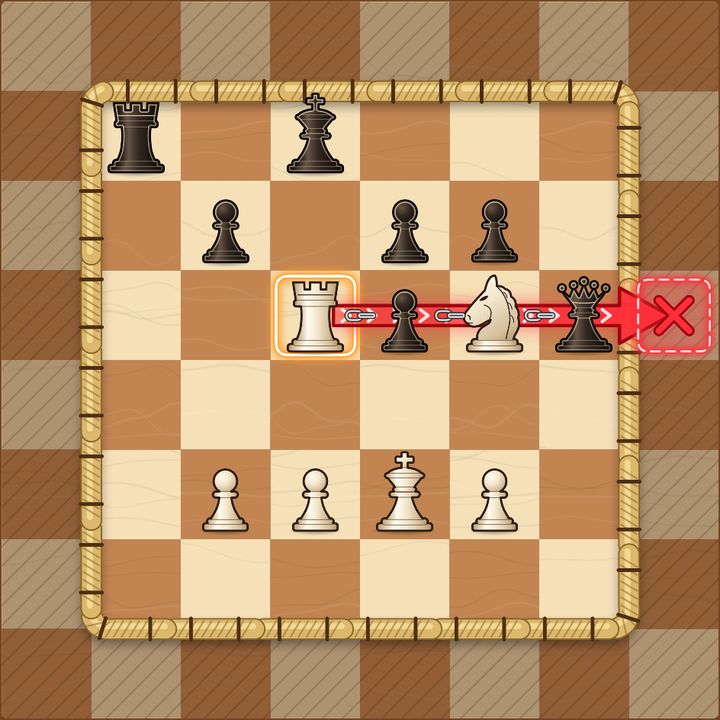
A real game, replayed from our balance arena: a chain of three pieces sliding and pushing out a queen.
Experiment 10 · Ring-Out Chess
What if you could shove chess pieces off the board?
- Move into an enemy and you shove it one square back. No captures.
- Lines slide like dominoes. Whatever leaves the board is out.
- First to push out six wins. No ring-out for 20 rounds? The ring shrinks.
Coming to iPhone. Part of Lab Pass. Try it first in its free interactive tutorial.
Against an AI with three levels, or Pass & Play on one phone.
Full rules
The twist
- Pieces move normally. A move that would capture becomes a push: your piece takes the square and the enemy piece is shoved one square further along your move's direction (a knight pushes along its long leg). Pawns push only diagonally.
- Chain: if more pieces stand behind the pushed one (any color), the whole line slides one square. The piece at the end that would leave the board is out of the ring.
- Kings are too heavy to push: a push whose line contains a king is illegal. Kings are walls.
- Win by pushing out 6 enemy pieces (pawns count). Own goals count: if your own piece falls off the end of your line, the point goes to your opponent.
- If 20 rounds pass with no ring-out, the ring shrinks by one square on every side (8×8 → 6×6 → 4×4 → 2×2). Everything left outside is out and scores for the opponent; a king caught outside loses. If a shrink catches both kings, or takes both players to 6 or more, the higher score wins; if the scores are tied, the bigger army wins (at least a pawn's worth ahead), otherwise it's a draw.
- No en passant. A pawn that pushes onto the last rank promotes; a piece pushed there stays what it is.
Base rules (every experiment)
- Pieces move like normal chess.
- No check, no checkmate: capture the enemy king to win.
- Castling only needs an unmoved king and rook and an empty path.
- 50 rounds without a capture, pawn move or destruction? The bigger army wins (equal armies: draw). Same after 150 rounds.
Inspired by push chess variants.
More experiments
Try another what-if

Hot Potato Chess
What if you had to pass a ticking bomb?
EXP-02
Meteor Chess
What if meteors fell on the board?
EXP-03
Battle Royale Chess
What if chess was a battle royale?
EXP-04
Laser Rook Chess
What if rooks had lasers?
EXP-05
Dragon Egg Chess
What if a dragon egg hatched on the board?
EXP-06
Splat Chess
What if pieces left paint everywhere?
EXP-07
Fuse Chess
What if two pieces fused into a monster?
EXP-08
Rock Paper Scissors Chess
What if pieces were rock, paper, scissors?
EXP-09
Ice Rink Chess
What if the board was frozen solid?